


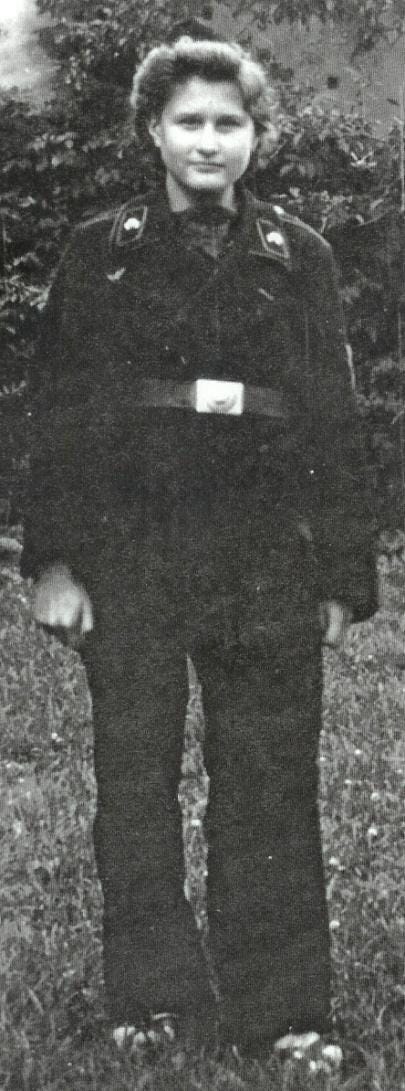
Photo of me wearing a Bavarian soldier’s uniform, which I tried on for fun.
LIFE UNDER THE RUSSIANS AFTER FATHER PASSED
The authorities replaced Father’s horses with two small Russian ponies, which were not suited for plowing. I wanted to ride one, so I got a chair and climbed on. But the horse refused to walk. Maybe it didn’t understand German?
Kaete pulled on the halter until he finally moved, but at every little dip in the ground the animal stood still, and I had to get down and lead him. Finally, I gave up. How I missed Father. He would have gotten after that horse, but now we had to manage by ourselves.
After Father died, only Kaete and I and a refugee family remained on the farm. We continued to take care of the animals. Because Father made a wise decision to not flee or release the animals, we still had our cows. We had also planted because Father said, “We are going to plant whether we stay or leave.” We were so thankful for his wise foresight.
The chickens were butchered because of disease, so we had no chicken meat and no eggs. And though we reaped a harvest, every so often hordes would come through and plunder all our provisions, taking whatever they found. Food was scarce, and so we hid everything.
One day someone tipped us off that the Russians were collecting cows again. We wanted to save the two we had left. But how do you hide cows? We drove the animals up two stairs into the empty chicken stall, then into a small chamber with a tiny window. That was quite an undertaking, squeezing those two in there tail-to-tail. Then we left them with a feast of grass, hoping and praying they would not “moo” at the wrong time.
Soon the Russians arrived for inspection.
“No cows?”
“Go ahead and look,” we said.
They peered in the empty barn and noted the empty stalls.
“Do svidániya! Okay then!”
When they left, we exhaled with relief.
The miller ground wheat for us. We hid the bags of flour in wooden boxes and covered these with hay to protect them from mice. The bakery was closed, so we taught ourselves to bake bread in the large, antique oven attached to the house outside. This oven could bake twelve to fourteen loaves of bread at once. All the stores had been plundered and looted, so we couldn’t buy anything anymore. But since we stayed on the farm, we always had something to eat, even if our meal consisted only of old potatoes.
HIDING FROM PROWLING RUSSIAN SOLDIERS
A Polish man we knew who worked in Habendorf during the war brought his brother, Woezek, to help us manage the farm. Woezek was an angel, truly a gift from heaven. He was our protector, made no demands, and advocated for us girls with the Russians.
At night, Kaete and I, along with all the women in the neighborhood, slept in barns or hid in our neighbor’s secret attic bedroom. As we hid, if the dogs barked, we understood the Russians were searching our house looking for girls. Then we’d hear shots, and we knew they were angry because they hadn’t found us. We trembled and shook. Would the soldiers force Woezek at gunpoint to betray our whereabouts? And if he didn’t, what would they do to him in their drunken rage? If a person did not confess, the Russians were known to just shoot on the spot.
When we came home in the mornings, we often found the house in complete disarray, drawers emptied, and the living room full of vomit—but thank the Lord, Woezek, our protector, was still alive, though he was pale as chalk from the stress and worry.
I often ran to my neighbor, Frau Pause, a widow from World War I and my mother’s friend. She hid me in a secret attic bedroom adjacent to her living room and pushed the armoire in front of the door so no one would guess another room existed. Frau Pause was a sweet lady and looked out for me. But I was sad we had to hide day and night—it was a beautiful May that year, and I missed being outside among the blossoming trees.
These were not normal times. You never knew what would happen the next hour. Once I saw some Russians approaching our farm. I grabbed the zinc bathtub leaning against the house wall and crawled under it, keeping very still. They didn’t find me. Another time when I caught sight of a soldier, I ran into the barn and hid between the cows in the feeding trough. We women had to be creative to evade the Russians.
One night, ten to twelve of us hid in our neighbor’s barn in the hay. Mice repulse me, but I figured it was better to sleep in a barn with them than fall into Russian hands! The old men closed off the entrance with dried brush and twigs to conceal the stairs. But we still trembled in fear. Would the men be forced to betray us?
Later in the middle of the night I noticed the hay moving next to me. I thought surely one of the soldiers had crept into our hiding place unnoticed. My heart started pounding, and I lay as still as a mouse, trying not to breathe. After a while I realized that the girl lying next to me had stirred. We lived under such stress that our nerves were just shot.
That first year after the occupation, danger lurked everywhere. I constantly feared that a Russian soldier would catch me. The authorities eventually outlawed such attacks but then struggled to rein in the hoodlums. Only under threat of the death penalty did the government restore law and order again.
We no longer lived under our own government, so we had to look for ways to survive. It helped that the Russians and Poles didn’t care for one another. They trusted the Germans more than they trusted their own countrymen. We used this fact to our advantage when possible and tried to play them against one another.
HOW A POLE ATTEMPTED TO KILL ME
In the meantime, more and more Poles came and occupied the farms. Woezek brought his parents and sister to stay with us.
Since Habendorf lay completely plundered, no shops remained open. Clothing items became very valuable. At Woezek’s recommendation, we hid Kurt’s suits in the barn in a box under the straw. Somehow his brother, Josef, found the hiding place and stole them. When Woezek asked him about it, he denied the theft. So Woezek asked the Russians to intervene. They arrested Josef and locked him in the basement of the command station in Reichenbach.
The next day we headed to “court.” Marta, who worked on our farm, and I went along as witnesses. Woezek set me on his bicycle handlebars, and Marta rode on the Russian escort’s, who provided protection and gave us access through each checkpoint. It was always a relief when the soldiers lowered their guns to let us pass.
Finally, we stood before the feared Russian commandant. We were fortunate that Woezek understood Russian as well as some German. He was able to help us present our case against Josef.
At first when they questioned the thief, he lied about everything.
Irritated and impatient with his prisoner, the commandant shouted, “I will hang you if you don’t confess!”
Josef paled but continued to lie. So the commandant sent him back to his cell. It looked like we had lost the case.
As we left the building, we heard a knock from the basement window. It was Josef. Seizing the opportunity, Woezek began shouting and gesturing wildly at his brother. I understood enough Polish to follow the gist of the conversation. “Don’t be so stupid, Josef! Admit everything, and tell us where you hid the suits. Why stay in jail?”
Finally Josef relented and agreed to confess. So all of us turned around and tromped back to the Russian commandant.
The commandant looked at Marta and me and scolded, “What are you doing, hiding things?”
“But the Poles keep stealing from us!”
“They aren’t allowed to do that,” he said. “You have to report theft at once. The culprits will get severely punished.”
We were glad to learn this. Later, because Josef confessed to everything, the commandant released him to return the suits. And we hung them back in the armoire.
Josef held a deep-seated grudge against Marta and me for this incident. Unfortunately, he was an alcoholic. One night I was peeling potatoes in the kitchen. Woezek sat at the table eating dinner. Suddenly Josef appeared in the doorway holding a large bayonet, obviously intoxicated. His bright blue, glassy eyes fixated on me in a trancelike stare.
“You, Malutka,” he shouted. “You tattle. I go jail.” He glared at me red-faced and raised the bayonet. “I going kill you!”
He lunged. I darted behind the kitchen table.
“Woezek, help me,” I screamed.
“You crazy, Josef?!” Woezek yelled.
Round and round the table we raced. Josef after me with his bayonet.
Oh, I was so scared. Out of the corner of my eye I could see Woezek crouching towards his brother, seeking the right moment to tackle him.
Suddenly Josef grabbed the overhanging lamp, the bulb shattered, and the light went out. My heart nearly stopped. Now the room was completely dark except for the small light from the radio, which helped me track my attacker’s moves and keep dodging him.
Finally, Woezek pounced and grabbed his brother, wrestling the bayonet away from him. I ran out the door and to Frau Pause, who hid me in her secret room where I stayed all night. My whole body trembled and shook, but I was so thankful to the Lord for his protection. I didn’t dare return home until the next day.
If Woezek had not been there, I know that Josef would have stabbed me to death and committed a terrible crime in his drunken rage. And he would have been very sorry. When sober he was usually nice and called me “ta ładna malutka,” which means “the pretty little one.”
Kaete told me that once, in a drunken rage, he went after his wife with an axe. Only by quickly leaping through an open window did she save herself. Terrible, what drinking can do to people. Many years later Josef died in a ditch in an alcoholic stupor, leaving behind his lovely wife and five children.
DRINKING WITH THE POLES
Podolski was another alcoholic Pole who moved in with us around that time. He’d say to me, “Germans sh_t.”
I’d say, “Yes, you are right.”
I saw no point in arguing with a drunk. But Kaete would get upset at his rants and provoke him. When he was in a drunken rage, he’d shatter bowls and scold, “Kaete sh_t, war prima, war good. Woman home, husband kaput.” Oh, when he was drunk, you could sure experience something. During those times I tried to stay out of sight.
The Poles considered declining a drink extremely poor manners. They told me, “You not drink, that like spitting on us.”
In particular, they would not let me refuse their special home-brewed potato whiskey. The first time I tried it, I took only a few sips but got very sick. I could hardly walk, suffered from a headache all night long, and experienced a terrible hangover the next day. That’s what a miniscule amount of their pure distilled alcohol could do to you.
After that, whenever the Poles were drinking, I left the premises. However, sometimes I could not get away and had to join them in raising a toast to good times. On those occasions I pretended to sip from my glass before pouring it under the table when no one was looking. At least they didn’t keep refilling your glass. If you had one drink with them, they were satisfied.
It’s no wonder the stress I endured in my teen years has affected me all my life!
“Under His Wings” are excerpts from Hannchen Gantenbein’s autobiography as told to Ruth Wood, her daughter. The account highlights God’s protection and guidance as she grew up in Nazi Germany, lived through World War II, and immigrated to the United States. Watch for monthly posts on the 20th!
Under His Wings/Table of Contents
How terrifying it must have been!
I was just reading Psalm 91 about remaining under his wings.
It seems like your mom was there, although it was not easy for her.
I pray that her trauma leaves and is healed in your bloodline.
Oh Sweet Ruth! What a story! Sooooo terrifying what your dear mama and the other girls and women had to endure. I sure see God's protection over her! Thank you for writing her story! Love you sweet friend!