


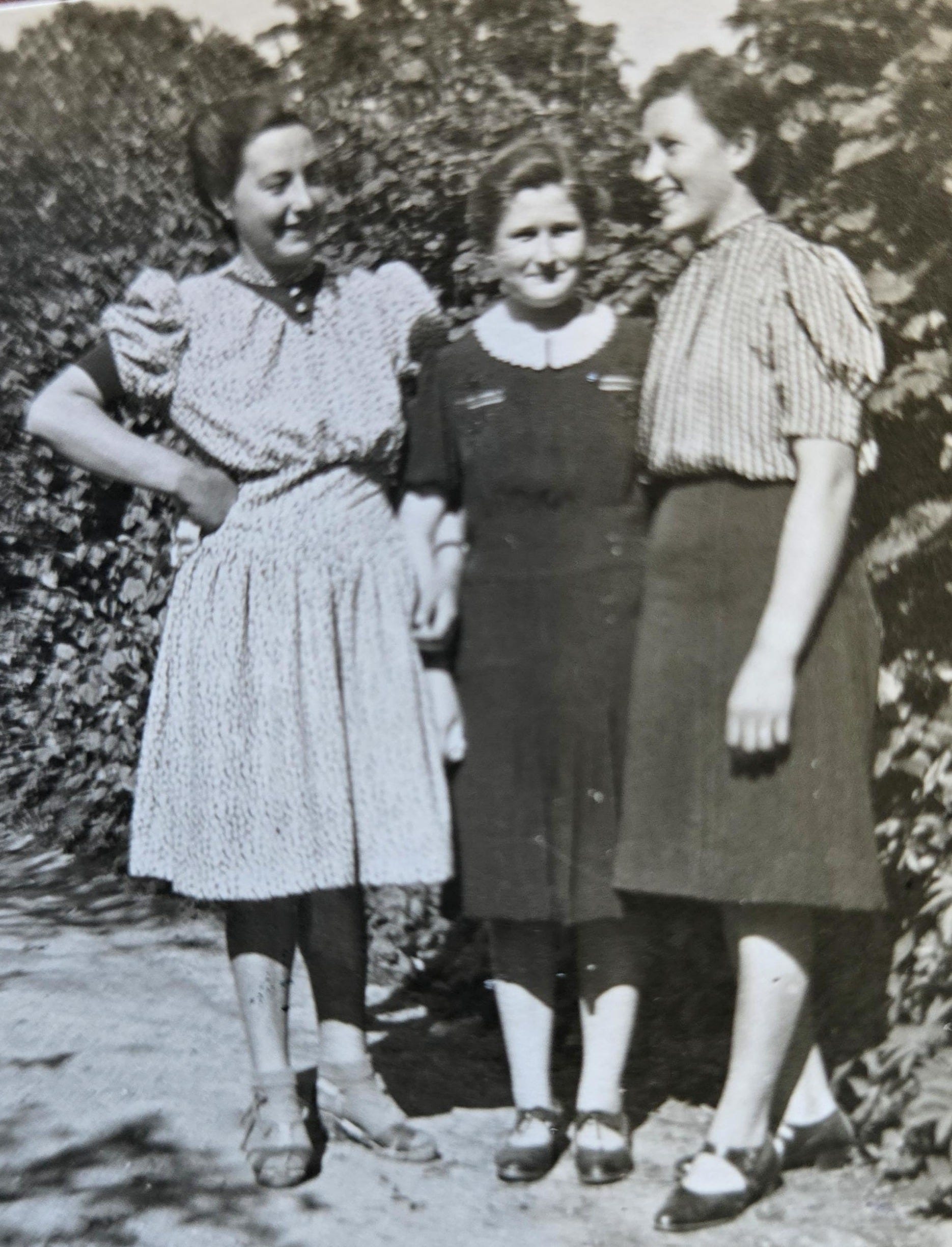
A friend, me, and Kaete (on the right)
WARTIME ROMANCE
Our neighbors had four boys. The oldest, Herbert, was Kurt’s age and had a bad case of acne. Herbert was a graphic artist, and every day after work, he came and sat with us as we ate. He’d talk and talk, all the while staring at Kaete to make sure he was making an impression.
Wherever Kaete went, Herbert always seemed to show up, and when she attended the Christian girls’ group, he escorted her home. She was sixteen and very pretty with her dark hair and green eyes. Kaete enjoyed being admired, and a dreamy look came into her eyes.
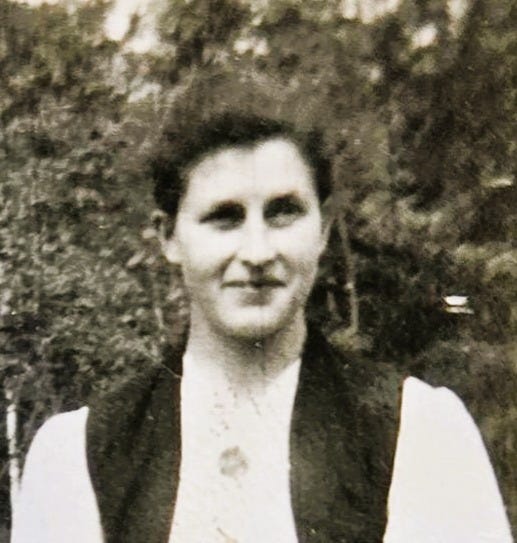
Once when Herbert brought her home, I hid by the entrance to eavesdrop and heard him give her a hearty kiss. I told her about it the next day. Oh, was she ever mad at me for being such a pesky little sister.
At eighteen Herbert was drafted and never came back. He died in action. What a sad day when we received the news.
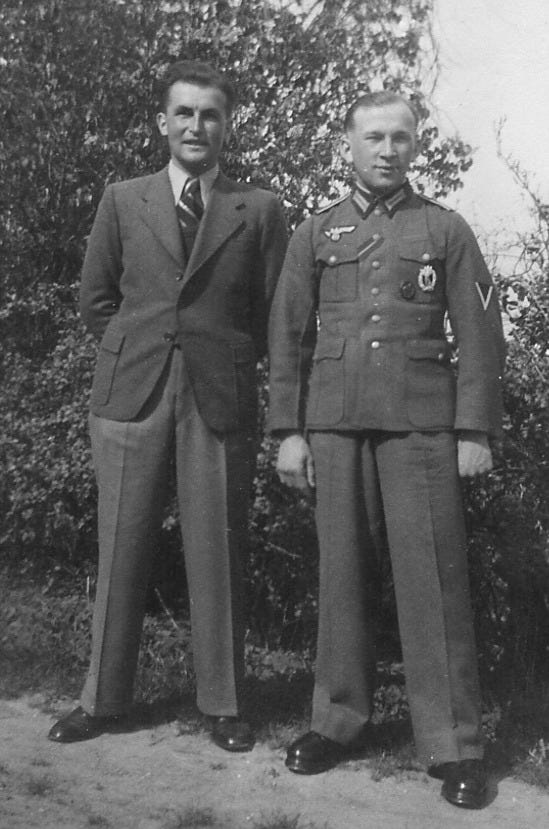
Kurt and Herbert
Once, Habendorf housed a tank division of Bavarian soldiers for six weeks because heavy snowfall blocked all roads, which had to be shoveled clear. Two of the soldiers stayed with us. They were very happy to be snowed in and said, “Here one can certainly endure the war.” One soldier, Herr Hinsel, was married and already had a child. The other, Martin, had a great sense of humor and the cutest Bavarian accent.
Martin fell head over heels in love with Kaete, and she with him. In the evenings we four played the game “Aggravation,” and he and Kaete kept refusing to knock each other out. Herr Hinsel and I protested, “That’s not fair. You two are cheating!” But we protested in vain.
We spoiled our two Bavarians. In the evenings while they were out on night watch, we heated bricks, wrapped them in newspaper, and tucked them into their beds, ensuring they had some warmth to come home to.
They told funny Bavarian jokes that made us laugh. Often other soldiers from the division came over to play games. They all sighed, “If only we could stay here until the miserable war is over.” It was a beautiful, happy time.
But then the day arrived when they had to move on, and the whole village came to see them off, waving goodbye. Many cried.
Kaete and Martin wrote each other constantly. I helped her compose special salutations such as “My ardently beloved Martin” or “My darling sweetheart.”
Herr Hinsel corresponded with Mother and always included special greetings for me. Then came the end of the war, and we never heard from either of them again. We assumed they both died in combat; otherwise, they would have written.
One of my teachers, a young man who taught for a short time, also fell in love with Kaete. As a result, I enjoyed special privileges. For example, he sent me to the post office or put me in charge of class during reading time.
After one special event, when he wanted to bring Kaete home, Mother told her I had to accompany them. Poor teacher—thwarted by the little sister.
A short time later he was drafted, and we never heard from him again. We assumed that he also died in the war. Oh, this terrible hero’s death!
Another time, Habendorf quartered a regiment from Sachsen. We took in four soldiers and two horses. One evening, news came over the radio that Dresden was under severe bombardment and the city was on fire. I will never forget how one soldier paced the room like a wounded animal, crying and wringing his hands in agony because his family was there. We all worried along with him. What would happen to them? We never learned if he lost loved ones or not because his company moved on shortly afterwards. He was only twenty-one.
We housed the Italians (Germany’s allies) next. They stayed overnight in our horse barn. Our courtyard looked like military barracks.
We also housed a Russian regiment that had surrendered to the Germans. They had gotten so tired of the oppression from the Bolsheviks, they wanted to fight with the enemy to free their own country. Oh, how they hated the communists.
Our German soldiers often warned us, “Don’t go outside alone—those Russians are all dangerous.” We did not fully understand what these warnings meant until later.
Being around all these soldiers was very interesting for us girls, and we were, of course, also interesting to them.
Once I ran an errand to the neighboring farm, which had taken in four tank soldiers. As I stepped into the house, they chorused, “A girl!” and surrounded me on all sides. One tall, dark, handsome young man said, “Please, will you go out with me tonight?” and told me where to meet him.
I retorted, “That won’t work. My father would never allow it.”
“Your father doesn’t ever need to know. Besides, I’m serious about you,” he insisted. And he kept trying to persuade me to meet with him that night.
Of course I didn’t go, heeding Father’s saying, “A soldier’s love is water in a sieve.” Or, “You never know what’s hidden beneath a uniform.” Later, after the soldiers had moved on, I saw my neighbor, and he said, “Fraeulein Hannchen, that young man was sure disappointed you didn’t show up. He was serious about you, and he was the son of a wealthy estate owner.”
“Oh, really?” I was not one bit sorry. I was only fifteen years old—in my mind, too young for romance.
OUR FOREIGNERS
During the war we employed foreigners—usually two hired hands and one maid.
Josef came from western Poland and learned German; he even spoke our dialect. He was a sweet man, a bit slow in his work, but faithful and conscientious. Josef loved to eat in great quantities and with gusto. For breakfast he consumed five boiled potatoes with butter or whey cheese and bread. As he ate, the sweat would run down his face. We’d never seen anyone eat the quantities this man consumed.
Once Josef’s uncle visited, and Josef proudly gave a tour of the farm as if it belonged to him. Another time as we sat around the table, an S.A. Nazi policeman came by and asked, “Where was Josef last night? Thieves have been about.”
Father said, “You better look elsewhere. Josef would never steal. I’d place my hand in the fire for him.”
“For a foreigner you should never put your hand in the fire,” the policemen countered. “Besides, for what you just said, I could arrest you.”
Father shot back, “I wouldn’t put it past you. You Nazis are lowlifes!”
“Well, what are you doing, letting Josef eat at the same table with you? That is forbidden!”
“This is our table, and under my roof, everyone eats together,” Father answered. Luckily, he and the officer had been school comrades, which called for loyalty; otherwise, he may have been arrested.
Yes, and then Josef applied for German citizenship. He was accepted, but unfortunately, the authorities drafted him into the military. With tears he departed from us, and we never heard from him again.
Since my brother, Kurt, was away serving in the military, we needed another man on the farm, and Antek, a Ukrainian, was sent to us. With black, penetrating eyes and jet black hair, he looked like the stereotypical criminal. He was lazy, and instead of working the potatoes with Josef, he would lie down in a furrow and sleep.
Once Father caught him in the deed. Josef had waved him over, and there was Antek, peacefully dozing in a potato furrow. Furious, Father yelled, “You lazy bum! It’s about time you get to work!” Antek leaped into the air, shocked awake. Father didn’t touch him, as physical punishment was forbidden, and foreigners had the right to complain to the authorities, but shouting wasn’t punishable. Antek didn’t stay with us long before he was ordered elsewhere. I was glad; he was not trustworthy, and something about him scared me. His black eyes seemed to glitter with hate.
Father’s sister, Tante Ella, also employed a foreigner. Once she was so irritated with the girl—my aunt was very short on patience anyway—that she slapped her. The girl reported her, and if Tante Ella hadn’t come with gifts of bacon and sausage to appease the authorities, she would have been jailed. Foreigners also had rights.
Then we had Baraska, a short, wiry Ukrainian with small, blue eyes. She loved to work and would get up early in the mornings around five to get started. Father had to tell her, “Don’t get up so early. The cows need their rest. They have to stay on their schedule in order to give milk.”
She knew quite a bit of German and used it, sometimes even quite cheekily. She was very feisty, and not even Father intimidated her. Once he was dissatisfied with how she swept up the straw and yelled at her. With fiery eyes she shouted back,
”You crazy. I good worker. Do good. You always scolding.” Father was astonished, and she was right—she was a very hard worker. I was impressed; I would have never had the courage to talk to Father like that.
Baraska often said, “We willing to work. Volunteer. We so afraid of Russians.” When we asked, “Why? Aren’t they your people?” She spit on the floor and said, “You not know what Russians are.”
Her boyfriend was a Belgian POW, and they hoped to marry secretly. At the end of the war she wanted to flee with us, but we stayed home. She left, and we never learned what became of her. Did the Russians capture her? Rumors flew that those who worked for Germany would be killed if they fell into Russian hands. They had seen too much of a different way of life, which threatened the communists.
Then prisoners of war from Belgium and France came to live and work on our farms. That’s when another Josef, a Belgian POW, came to work for us. He and some other POWs were held in a hotel and given a considerable amount of freedom.
In the mornings they marched through the village on their way to the farms. They were happy to work, enjoyed good food, and were treated well—for them, the war was over.
Romance sometimes blossomed between farmers’ widows and these young men. I knew a couple of Belgians who, after the Allies invaded, went home but soon returned to marry and take their brides back to their country.
Josef was twenty-four years old, built rather delicately, and was always cheerful. I loved to hear him sing in French, his mother tongue. He liked being in Germany and also cultivated a secret love. A friend of his fashioned a ring for me out of a two-Reichsmark silver coin I gave him. I later smuggled this ring past the evacuation checkpoint.
We never learned what happened to Josef at the end of the war either. Everything was too chaotic. War brought continual comings and goings and constant farewells.
Readers, I think you’d enjoy the account of John Sprigg’s experiences related to Corrie ten Boom, so I’ve made it available via Notes which you can access here.
“Under His Wings” are excerpts from Hannchen Gantenbein’s autobiography as told to Ruth Wood, her daughter. The account highlights God’s protection and guidance as she grew up in Nazi Germany, lived through World War II, and immigrated to the United States. Watch for monthly posts on the 20th!
Under His Wings/Table of Contents
Hard to imagine living through it…
I’m a history lover this is all so interesting to me. 🙋♀️