


Photo by Nadiia Ganzhyi on Unsplash/From Museum in Ukraien, Odessa
THE WAR ENDS
Many women and children from Habendorf had already escaped to Czechoslovakia, but farmers and their families were always the last to leave because the entire country depended on them to keep food on the table. The Russians were coming closer every day. We had already packed our box cart with bedding, dried noodles, fruit, flour, sugar, some clothes, photographs, and the Bible.
Our foreigners also wanted to go with us. We asked them, astonished, “Why don’t you want to go to your own people?”
They answered, “You not know Russian.”
No, we didn’t, but we would soon find out.
They explained, “We voluntary work here. Russian find out, they kill us.”
As Habendorf’s agricultural leader, it was up to Father to decide whether the village farmers fled or stayed. He struck out on his bike to investigate the road conditions. When he returned, he said, “The roads are congested with soldiers, refugee wagons, cows—it’s a big mess. The war is almost over. It’s nonsense to leave.” And he was right.
So he gave the order: “Habendorf farmers will stay home. Please do not release the animals. All is lost anyway. Here we are more protected than on the road.”
So we unpacked the wagon and fed the animals as the sounds of cannon fire came closer and closer. German soldiers came by heading west. We began hearing terrible stories of things the fleeing refugees endured when the Russians caught them on the open roads. We were deeply grateful for Father’s decision because at home we had places to hide.
Those who made it to Czechoslovakia were likely to be tortured, mistreated, raped, and plundered by the Czechs and Russians. Many children died on this trek, and I knew several. Mothers alone, with their children in baby carriages, fled across the border. Husbands and fathers were either fighting or had died in combat.
War is particularly hard on children. Milk became scarce. Babies whimpered, no longer strong enough to cry. One baby in our village became jaundiced and stopped growing before it died.
How much pain and suffering we witnessed while still so young. No one can imagine the suffering, grief, and stress of war unless they, too, have lived through it.
THE RUSSIANS ARRIVE IN HABENDORF
On May 8, 1945, the day Germany surrendered, the Soviet Red Army and the Communist Polish Army descended on us with their gunners. Breslau, a city east of us, had fallen. We were caught in the crossfire between German troops entrenched in our hills and the advancing enemy.
Father told us to lie down by the entrance to the courtyard, next to the barn wall. He felt this would provide the best shelter against potential grenade splinters. Oh, how Kaete and I shook with fear and prayed in desperation. A whistling sound screeched overhead, then a loud Boom. Was that behind our barn? Again, a second time. The air cracked, popped and detonated all around us in a horrendous noise.
Little by little it grew quieter, and we cautiously sat up. Father, as the first to rise, immediately inspected the property. In the orchard behind the barn, he found two large grenade craters three feet deep and four or five feet wide. Had they landed at the gate, we would not have survived. If the barn had been hit, it could have started a fire. Later we learned that these grenades came from friendly fire.
Now with the Russians close by, we figured out a hiding place for emergencies. The pigeon loft in the house could be reached quickly from the attic and became inaccessible to any prowlers once the ladder was pulled up.
Night fell, and we went to bed fully clothed, prepared to escape to our hideout the moment the dog barked. In the distance, shots rang out, dogs barked, and we heard screams.
Strangely enough, neither our dog nor the neighbors’ made a sound when they usually barked at the least provocation. It was so quiet we actually slept a little. The next morning when we learned what other Habendorfers went through, we were shocked. Surely angels had watched over us.
TERRIBLE NEWS
Before I tell this story, you need a little background.
About one and a half kilometers outside Habendorf, surrounded by woods and meadows, stood two water-powered mills, the Brook Mill and the Border Mill. A torrential river powered the water wheels that ground the wheat into flour. Since it was May, the water was running at peak levels.
Mother’s friend and her husband lived at the Border Mill with their two daughters, Emma and Lisbeth. The girls had lost a husband and a fiancé in the war, and Emma had a child. Together they worked the farm that belonged to the mill, and the women did the men’s work, tilling the ground with machines and horses.
As I said, that first night the Russians entered Habendorf, no soldiers came to our house. The following day around noon our neighbor walked into the courtyard. White-faced and continually brushing tears from his eyes, he reported what happened the previous night:
“Many women had fled to our farm. The Russians raped them in beastly fashion. Most of the soldiers were drunk and on a rampage, breaking things. They threw my grown son on the manure pile and trampled him. It was terrible.
“I was worried about my Border Mill relatives, wondering if they had also experienced such terrible things the previous night, as they live on a well-traveled road. On the way there I became more and more anxious. I arrived to find the place in absolute shambles. Lisbeth lay on the sofa completely soaked, incoherent.
"Finally, I learned that she, her father, mother, and sister had all thrown themselves into the river to commit suicide. Emma was still holding her child when they fished her out. Lisbeth didn’t know how she came to be on the sofa.
Some Russians were there who tried to explain to me what had happened. They must have been the ones who rescued Lisbeth. All the others are dead. My relatives experienced unspeakable horror.”
We stood shocked at his words and didn’t know what to say. Then sobbing, he turned around and left. It was the last time we saw him.
The following day, we received more shocking news. After coming to our house, this neighbor had gone home, and he and his son and their wives hung themselves—the four grandchildren lay strangled on the floor. The people who found them were able to resuscitate the three girls, but the little boy didn’t make it.
An aunt took in the orphan girls and raised them with her own three children—a great sacrifice during the post-war years with the scarcity of food and cramped living spaces. Women like these were heroines. Most of them raised the children alone since their husbands had died in the war. They didn’t complain but worked hard to survive.
The atrocities that occurred when we were conquered caused many people to lose their will to live because they could no longer see any hope for the future. It was unthinkable that things like this could happen to people we knew.
We heard about other tragedies that occurred. Some villagers died during the cannon fire over Habendorf. One man’s leg was shot off, and he bled to death. Another woman, whom I knew well, died from a grenade splinter. Words fail me to describe the terror, the horror, and the gruesomeness of war.
In our neighborhood, the Russians shot and killed a fleeing German soldier. No one knew who he was. Father and several others dug a shallow grave and buried him right where he was gunned down in the neighbor’s yard. We always wondered whose father, son, or brother he was. His death was so very sad.
Around that time also, two German soldiers came to our house and asked us to hide them. They were only sixteen and eighteen. We told them to hide in the barn and secretly brought them food and civilian clothes. The following day, Father drove them a ways down the road in his wagon. They were heading west, trying to get back home. None of the soldiers wanted to be captured by the Russians.
After the invasion, everywhere you went, people told horrific tales. This was very frightening to me. However, today I can see that it is easier for youth than their elders to retain hope for a better future. In a way, our youthful innocence protected us. We did not fully understand what it meant to be occupied by the enemy and what it would mean to be stripped of citizen rights and government protection. We felt vibrant, strong, and adventurous. Above all, we were determined to survive.
RUSSIAN AND POLISH OCCUPATION
Habendorf’s aristocrats endured the same fate as so many others. Lord von Seidlitz had fallen in defending the eastern front at Breslau in February 1945. The Russians plundered the palace and raped seventy-year-old Lady von Seidlitz. Then they forced the family and all the servants to vacate the estate, allowing only a few possessions in their backpacks. Today the estate lies in ruins as you can see from the photo below.
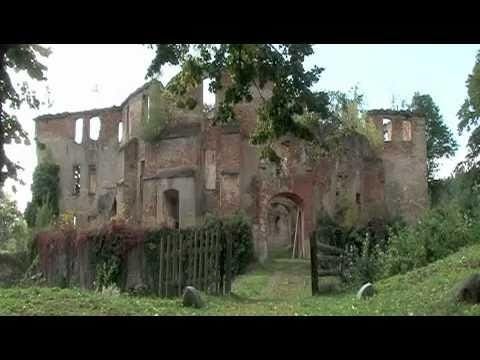
Later I learned that the family fled to West Germany. Lady Von Seidlitz was now penniless as well as helpless. As an aristocrat she had never learned to do any work; she did not even know how to sew on a button. A former servant kindly took her in. When Lady Von Seidlitz died, she was buried in a pauper’s grave. I have good memories of her as a lovely Christian lady.
The Russians and Poles now occupied the palace. They knocked out windows and doors and stole everything. Later we saw Polish women walking around wearing the palace table cloths as shawls; they didn’t know what the table cloths were for. The conquerors rode the stolen bicycles and wore Lord Von Seitlitz’s pajamas in public. It would have been funny had it not been so heartbreaking.
Many of these soldiers had come from very primitive areas and were unfamiliar with modern life. The Russians were completely obsessed with clocks and made sure to “free” us of them. One Russian had pocketed an alarm clock. When it suddenly went off, he yelped, flung it from him, and shouted, “Help! It’s the devil!” Another Russian tried riding his stolen bike and wasn’t having any success. In a cussing rage, he threw it into the ditch and proceeded to stomp on it. A sight to behold! We smirked with “Schadenfreude” at the conquerors’ vexations.
But the trials of the occupation had just begun.
“Under His Wings” are excerpts from Hannchen Gantenbein’s autobiography as told to Ruth Wood, her daughter. The account highlights God’s protection and guidance as she grew up in Nazi Germany, lived through World War II, and immigrated to the United States. Watch for monthly posts on the 20th!
Under His Wings/Table of Contents