


THE VON SEIDLITZ ESTATE
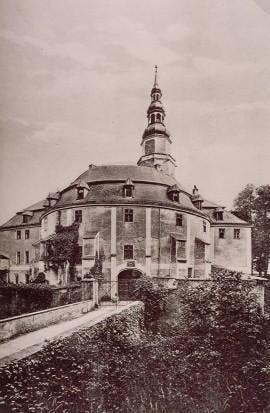
Our East German village had its own “castle,” a small palace where the aristocratic Von Seidlitz family lived. They employed many people who worked and lived on the premises. Their servants maintained the park, managed private forest land, cultivated trees, and fed wild animals (such as deer) in winter. The forest was the family’s private hunting ground where they hunted pheasants or rabbits.
The thirty-five-room palace included a chapel with an organ, and I attended Bible study there. Lord and Lady Von Seidlitz were very devout Christians. They were kind to their servants and always cared for the villagers, providing the sick with medicine. The family occupied their own private pew in the Rosenbach Lutheran Church and, in 1933, donated its bells.
Today, the estate lies in ruins. In another post I will share what happened to the family after the war ended and the Russians occupied our region.
SCHOOL DURING THE WAR YEARS
War. What a terrible word. It started September 1, 1939. On August 31st our school took a bus to the Schneekoppe, a nearby butte, and hiked for four hours. From the top, we were able to see Czechoslovakia and saw airplanes already flying overhead. Everyone hoped for a quick end to the conflict. Sadly, it was to be our last field trip.
I was ten years old when the war began. Because of a teacher shortage during the war, several schools in neighboring areas closed, and two merged with Habendorf. At first, religious studies continued, with separate classes for Protestants and Catholics.
Later, the government dropped religion from the curriculum altogether. Instead, we learned about Hitler and politics. When Hitler gave a speech on the radio, our teacher, Herr Hoffman, crammed the whole school into the largest classroom to listen. Of course we didn’t mind—we welcomed any distractions from schoolwork.
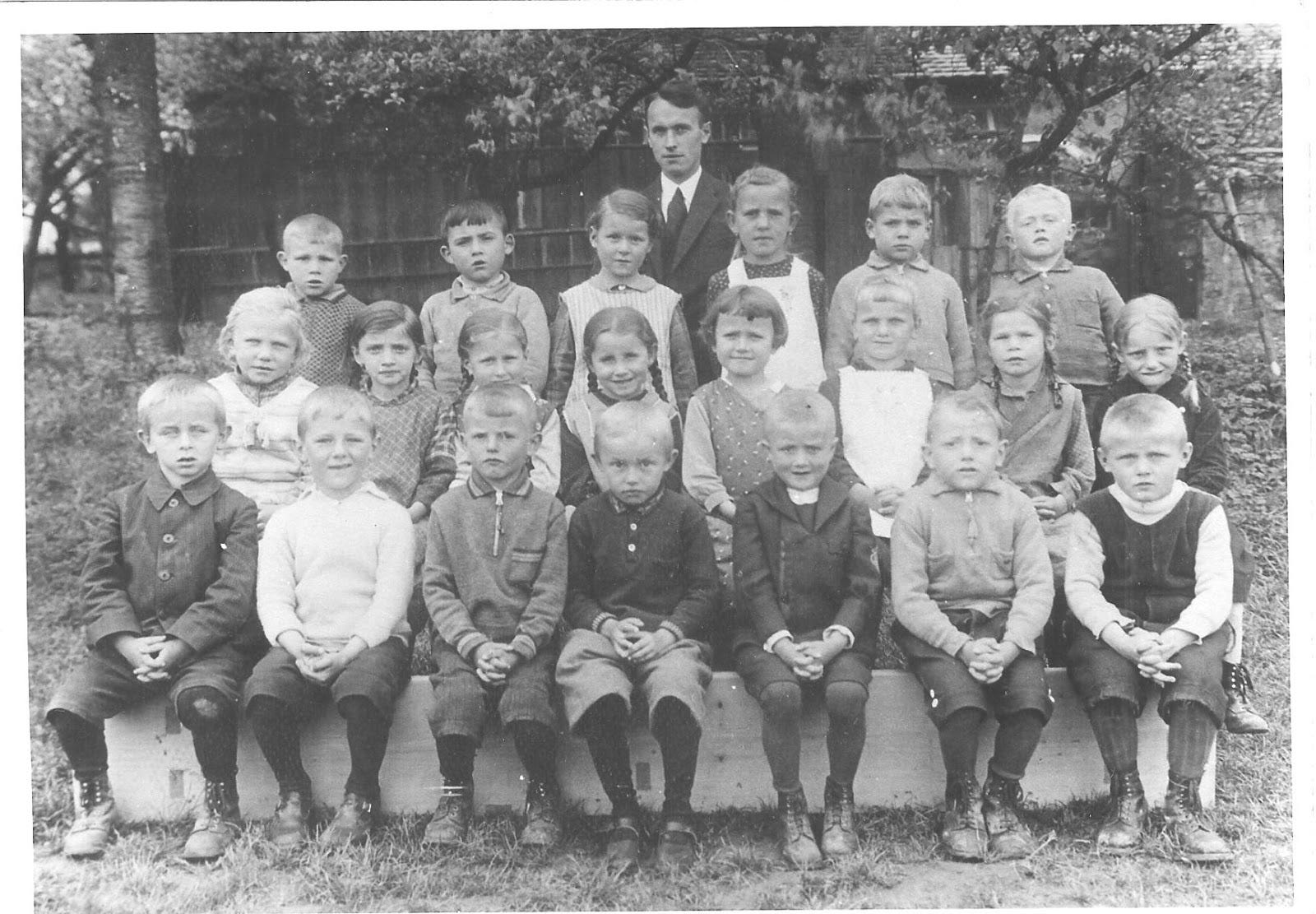
I am in the middle row, third from the left.
The government required schools to participate in the war effort. For example, in the spring, we students planted cabbage in the estate fields belonging to Lord and Lady Von Seidlitz because their hired help was away, fighting in the war. We received a small payment and could even earn extra money if we volunteered after school hours. I liked that.
In the fall we helped bring in the potato harvest. It was very important to keep sowing, planting, and harvesting because of the trade embargo against Germany. In the early 1940s, Germany fed and clothed 80 million people and still found the resources to make war.
Before the war, we sang Christmas carols in school, but this practice quickly disappeared. Because Hitler hated all things Jewish—and since Jesus was a Jew—he replaced Christmas with the Festival of Lights, celebrating the winter solstice. We sang songs to the sun, the moon, and the stars like the early Germanic pagans. (You can perhaps understand why America’s politically correct culture and efforts to banish God and Christmas from public life feels strangely familiar to me.)
At home, however, and in our churches, we cheerfully celebrated the holiday as before—with a Christmas tree and the manger.
Hitler upheld our ancestors as models of rugged strength and believed in raising German youths like Spartans—tough as leather, fleet as greyhounds, and hard as iron. Herr Hoffman drilled this phrase into us regularly. Here is what it meant:
Tough as leather: Endure cold, heat, and hunger without complaining—don’t whine at every little thing.
Fleet as greyhounds: Be the swiftest athletes, the quickest learners, and the fastest workers.
Hard as iron: Be tough—especially on yourself. This also included living by a strict moral code. Our elders taught us to always tell the truth and punished liars severely—usually with a beating. We were raised with the saying, Those who lie once will not be believed again, even if they tell the truth.
All children—ten years or older—attended mandatory Hitler Youth meetings. During this one-hour Wednesday afternoon program, we learned something about Hitler’s life, played games or did crafts, and exercised. Hitler wanted to raise a super race, so he emphasized exercise as well as good posture for health reasons.
The longer Hitler ruled, the more we saw propaganda against Jews increase. Teachers indoctrinated their students, saying Jews lied and cheated the German people out of their wealth. Slowly people started believing these kinds of myths.
No Jews lived in Habendorf. We did not know about the concentration camps but heard rumors that the Jews were being dispossessed and evacuated. Rumors floated around that they were being taken to Palestine.
Remember, we lived in a small rural village, and during the war, few people traveled. Only soldiers were allowed to use transportation. Civilians needed a special permit to use the train. Radio was our only connection with the outside world, and we listened to foreign stations at great risk—this was forbidden. We wondered who was telling us the truth.
I was thankful for my good home—my parents stood against Hitler and would not hang his portrait in their house. The authorities questioned them about their genealogy and examined them for Jewish features, looking for a prominent nose or darker complexion. My parents could not understand this demand but were forced to comply.
At home Mother and Father kept saying that Hitler was a little Antichrist. Today I understand this well. As a child, I didn’t. I could not have cared less whether we said “Heil Hitler” or “Good Morning,” for example. But from the perspective of an adult, I see why my parents railed against the arrogance of this required greeting. “Heil Hitler” essentially meant “Hail to King Hitler,” as if he were asking for allegiance close to worship. How easily we mimic expressions as children, unaware of what we’re saying.
During his first six years in power, Hitler created economic prosperity with jobs for everyone—a blue-collar worker could even afford to build a small house. And Hitler built the autobahn. With childish shortsightedness, I sometimes wondered why my parents railed against him—everything seemed to be going so well.
However, lively discussions with Father and Mother protected me from the propaganda at school. Every time my teacher made snide remarks about Jews or Jesus, I always thought, Herr Hoffman is wrong; my parents know better. This is why parents need to cultivate good relationships with their children. Discussing issues helps children think for themselves. I’m so grateful to the Lord for the wise parents and stable home he gave me.
My education ended in eighth grade. Only students with a certain grade point and teacher’s approval were allowed to attend the Gymnasium in Reichenbach. Herr Hoffman recommended me, but my parents refused to let me go. Though I was disappointed in their decision, they had good reasons. Attending Gymnasium would have meant living away from home while completely under the influence of the Nazi Party.
It didn’t matter anyway. Four weeks after I graduated from eighth grade, Mother had a stroke, and my childhood ended abruptly.
SAYINGS DURING WORLD WAR II
I once read a joke that went like this: A gentleman was given a gift of three portraits—of Hitler, Goering and Goebels. “What on earth shall I do with these?” the man asked. Another replied, “That’s easy. Best you just hang all three together.”
Many Germans weren’t Hitler-friendly, and when such jokes went around, you had to be careful to whom you repeated them so that they weren’t heard by the “wrong” ears; otherwise, you could get arrested.
Another popular saying went like this: “Enjoy the war. Peacetime will be gruesome.” We experienced this—literally. During the war, we in East Germany enjoyed relative calm, while in West Germany people suffered and died under constant air raids. After the war ended, our “peacetime” turned into a nightmare under the Russian/Polish occupation.
“Under His Wings” are excerpts from Hannchen Gantenbein’s autobiography as told to Ruth Wood, her daughter. The account highlights God’s protection and guidance as she grew up in Nazi Germany, lived through World War II, and immigrated to the United States. Watch for monthly posts on the 20th!
Under His Wings/Table of Contents
I love how you are keeping this history alive!
I just read the 3rd chapter of your mom’s story how very interesting and I am so enjoying it. Thanks again for sharing.