


MY CONFIRMATION
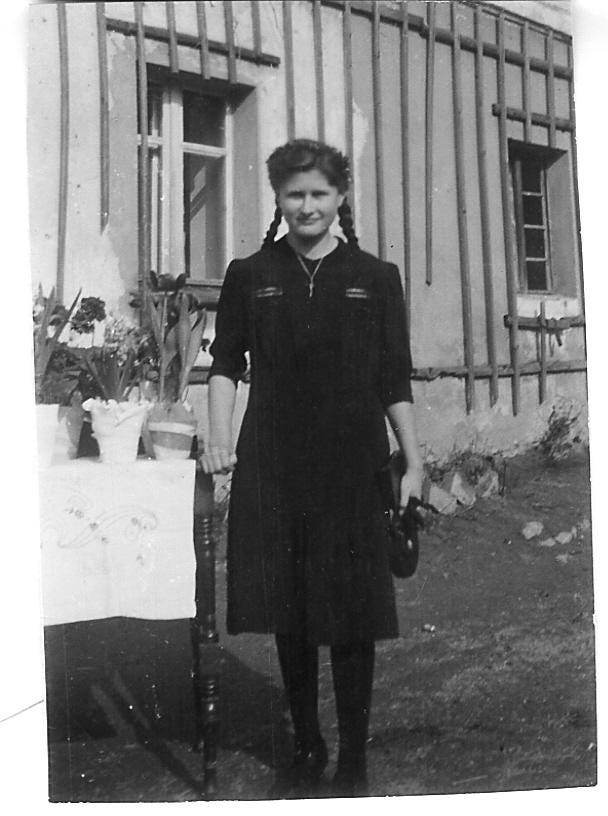
In January 1943 I turned fourteen, and on March 7th I was confirmed. For two years prior to the big day I attended confirmation class once a week after school. Our pastor stressed that Jesus was nailed to the cross as a sacrifice for our sins and that we must believe in Him in order to be saved. To be confirmed meant saying “yes” to Jesus’ sacrifice for my sins.
A few days before the ceremony, the pastor encouraged us to examine our lives and to make things right with others—to apologize to people we may have hurt, or if we had stolen something, to come forward. His reasoning was that we should not partake of communion in an unworthy manner. So we all went first to our teacher and asked for forgiveness if we’d irritated or troubled him—some cried during this confession—then we went to our parents, which also wasn’t easy. Some boys went to neighbors to admit they’d stolen apples from their garden and asked forgiveness.
We decorated the church with garlands of pine boughs and prepared our confirmation clothes. We girls looked forward to wearing silk stockings for the first time as a rite of passage. Up to that time we had always worn cotton ones in summer and wool ones in winter.
The day of my confirmation, I stole admiring glances at my terrific legs in those silk stockings! We girls wore black dresses with myrtle wreaths in our hair, and the boys wore dark suits and boutonnieres. I did not foresee that I would wear that dress for many years of mourning.
As the bells rang, we proceeded into the church and seated ourselves in the reserved pews in the church nave. Quite a few of my relatives came, also my godfather, Onkel Friederich, who was a Jewish man who had converted to Christianity. Oh, how we hoped he would survive the war.
The pastor’s message was, “Hold fast to Jesus Christ, the beginning and completer of all things.” In my heart I promised to follow Him forever. By threes we approached and knelt at the altar, and each of us was given a special Bible verse for life. Mine read, “Be joyful in hope, patient in affliction, faithful in prayer.” (Romans 12:12). Then we were allowed to take communion for the first time.
At home we celebrated with all the relatives who came for the great occasion. Neighbors brought flowers, and I received cards and gifts. The table stood beautifully decorated with greenery on the white tablecloth.
Mother had hired a cook for the day, and two maids also helped prepare the feast, which allowed her the freedom to entertain. The main dish was roast goose with all the trimmings. The grand finale of the meal was a unique lemon dessert, very light and fluffy, a heavenly concoction—I’ve never had anything quite like it since.
I was now officially an adult. Five weeks later Mother suffered a stroke.
MOTHER’S STROKE
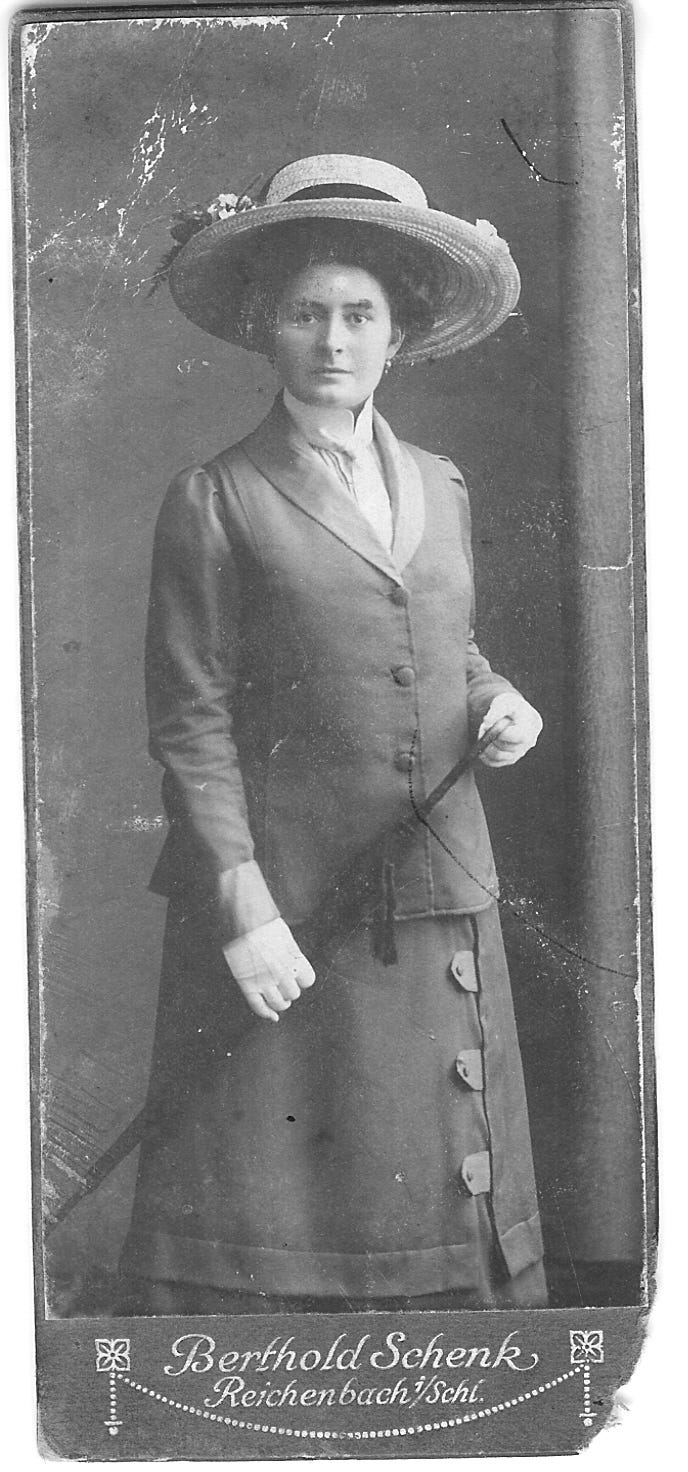
For some time, Mother had not felt well. Her blood pressure was too high, and the doctor told my father to send her on a vacation to recover her health. Father said, “No, that will not work. I need Mother here. I can’t run the farm without her.” And then he had to run it without her after all.
I was already in bed on April 12, 1943. Suddenly I heard Father shout, “Come help! Hurry!” I knew immediately that something was terribly wrong and leaped out of bed, frightened.
Mother lay collapsed in the barn, where she had been assisting the birth of a foal. She was unconscious, half-dead. We carried her into the house and began cutting the dress off her because she was sweating and couldn’t seem to breathe.
I kept thinking, “No, no, no, it cannot be. It’s too soon for her to die.” We tried to make her comfortable, doing all we knew to save her. Kaete ran to the neighbors who had a phone and called the doctor.
After the doctor arrived and examined her, he said, “There’s little hope. She has suffered a massive stroke and is paralyzed on her right side.” This news was horrible for all of us. How could life change like this from one minute to the next?
I went outside into the garden. I couldn’t comprehend no longer having a mother. In my heart I screamed to the Lord, pleading, “Please leave Mama with me a little while longer. Please, I want to have more time to show her my love, to just be with her.” I was not ready to let her go.
In my desperation I prayed as I had never prayed before. Over and over I begged God to spare her.
And to our joy, she continued to breathe. We gave her strong coffee administered in drops.
On April 13th, the evening after Mother had her stroke, we suddenly heard a knock at the door. To our utter surprise, there stood Kurt. After one and a half years he was sent on leave, and now he came home—only to find Mother in crisis.
It was so sad for all of us. How much Kurt had looked forward to a reunion with his beloved mother. Now she didn’t know him, and her life hung by a thread. He often brought her flowers and freshly cut birch branches and sat by her bed, though she was not coherent.
Kurt plowed the fields every day and was happy to be home despite the sorrow with Mother. He loved bowls of green salad and also “tortes,” relishing the good food. After three weeks’ leave, he had to return, and Mother had not recognized him the entire time he was there.
MOTHER’S CARE
Kaete was twenty and I was fourteen when Mother suffered her stroke. Little by little over a period of six weeks, she came to and recognized us again. Her right side was lame, and her speech was a bit slower and a little slurred, but she could speak again. Using a beaker, we infused her with soup and other fluids and spoon-fed her like a baby, making sure she swallowed.
Since Mother was no longer able to work, we took over her chores. Kaete shouldered Mother’s responsibilities in the barn and the outdoors. I began cooking for seven to eight people and tended the chickens, the geese, and the pigs.
Father did all he could to make life easier for Mother. No task seemed too much for him when it came to helping her, even though he was also sick with bleeding ulcers.
Caring for Mother added an extra layer of work to the ongoing demands of the farm, but no one complained. We felt she received the most loving care at home and would never have given her up to the hospital.
Unable to work, Mother often said, “If I could only peel potatoes and help you with something. I am such a burden.” And she would cry.
We were simply glad to still have her with us. I could talk things over with her. She reminisced about the old days and recited many songs for me because now she had time for this. But above all, we could talk about the Lord Jesus.
The last two years with Mother were some of the most beautiful and blessed times of my life, a precious gift from God. I didn’t go anywhere. Even in the evenings I stayed home. While other young people went out walking together, I preferred being with Mother, Father, and Kaete. We enjoyed such cozy times together.
Oh, how we missed Kurt. We worried and prayed. The news about the war was terribly upsetting. At home we dealt not only with Mother, but as Father’s ulcers worsened, he soon required our attention too. To care for him, I needed to cook according to special dietary restrictions.
These were difficult times, and yet I have to say that I had no time to feel sorry for myself or to complain. I was where God wanted me and liked feeling needed. I felt happy and contented even though I was often tired from the night watches with Mother.
“Under His Wings” are excerpts from Hannchen Gantenbein’s autobiography as told to Ruth Wood, her daughter. The account highlights God’s protection and guidance as she grew up in Nazi Germany, lived through World War II, and immigrated to the United States. Watch for monthly posts on the 20th!
Under His Wings/Table of Contents
LETTER!
What a bittersweet chapter! Rejoicing over your dear mama's faith and so sad over the tragedy of your Grandmother and her stroke! Hard times but their trust in Jesus prevailed. I love the verse selected for her! As usual, your writing is wonderful and thank yo for this story!
Letter