


MY HOME
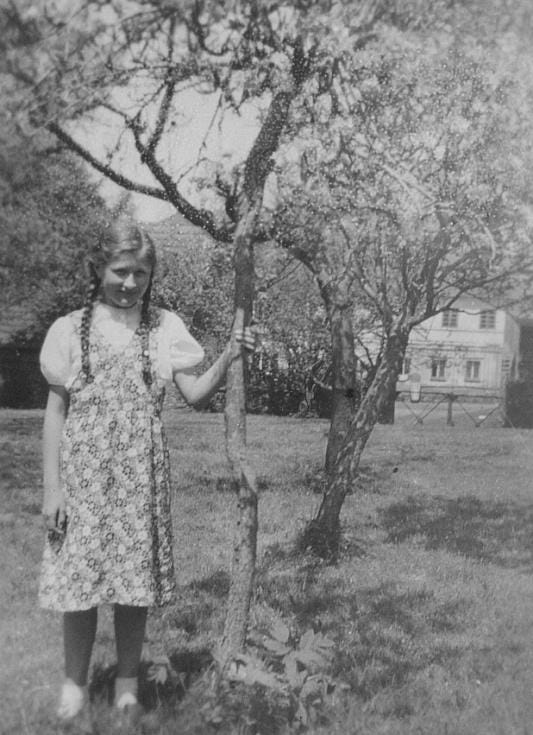
I was born on a 300-year-old farm in the village of Habendorf in the province of Silesia, Germany (near the borders of Czechoslovakia and Poland). Earliest records mentioning our village date to the 1200s. Slavic and Germanic tribes settled here and over the centuries, they saw Polish, Bohemian, Austrian, and Prussian rule before Silesia, in 1871, became part of a unified Germany. This volatile history played a significant role in what happened to us after the war when Russia and Poland forced all Germans from the region.
In 1943 the population of my village was officially listed at 927; today it stands at 516. World War II brought great upheaval, changed the borders, and displaced millions of eastern Germans. To find my birthplace on a current map today, you must look for Owiesno, Poland.
THE FARMHOUSE
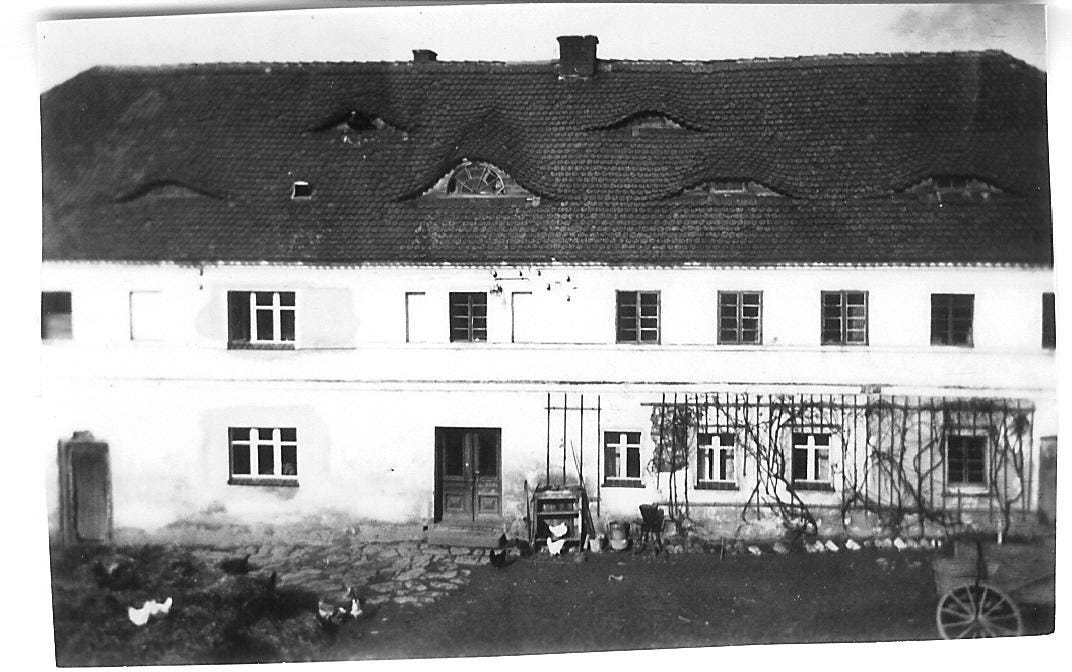
My great-great-grandfather, Wilhelm Becke, acquired the farm around 1875. This house and the surrounding buildings were very old. The three-foot-thick walls provided ample window shelves—wonderful for displaying plants and flowers.
From the front door we entered a foyer tiled with rough, reddish stone. To the right stood our indoor water pump (the courtyard also had one), and to the left, a staircase led to a large landing from which we accessed four bedrooms.
The small bedroom led to our provisions chamber, a very large room the width of the whole house, which kept cool because it faced north. We had no refrigeration, and so in this room we stored smoked sausages, bacon and ham, canned goods, and dried apples. Dried peppermint and chamomile hung from the ceiling. Antiques filled one corner—a spinning wheel, colorful petroleum lamps in various sizes, my grandfather’s war medals pillow, old photos, and old-fashioned greeting cards, some even written on birch bark.
From the second-story landing, a stairway led to a huge attic where we stored wheat kernels. An old cabinet kept Father’s guns, a saber, a saddle, and other miscellaneous items. From the attic you could lean a ladder against the wall to reach the pigeon loft, where I later hid from the Russians. In the photo, you can see the loft’s small dormer-like windows protruding from the roof. This was a good place to hide from Russian soldiers on the prowl.
We had no running water in the house but filled our containers at the water pump in the foyer. The kitchen was also where we bathed. Every Saturday, Mother first heated hot water in a large basin on the stove. Then she brought in the tin bathtub, filled it with warm water, and bathed us one at a time. The shampoo was an awful concoction that made your hair clump together and created such a mass of tangles, you could barely get a comb through. I remember how good it felt to put on a clean nightgown and go to bed afterwards.
In the summers we ran barefoot and took footbaths daily. Once when I was really little, I liked the footbath so much that I put the rest of myself in the water too—fully clothed!
Along the wall, next to the kitchen stove, stood a low bench where we kept large iron pots and pans. Cooking utensils hung above the bench. A table with a porcelain bowl stood in the corner where we washed our faces and hands. The house did not have a bathroom—we used an outhouse.
Nearby stood a work table where we washed dishes in a wooden bin. Using no dish detergent or soap, we rinsed the dishes first and then washed them in hot water. This method was customary in those days.
Our radio sat on top of a cabinet that stored our dishes, silverware, and staples such as flour and sugar. A lamp hung from the ceiling over the kitchen table, and this cozy corner is where I did my schoolwork. In fact, most of our family life took place here.
The kitchen contains so many memories. One memory involves the radio, the lamp, swaying, and a drunk Polish man trying to kill me with a bayonet. But that story is for another time.
“Under His Wings” are excerpts from Hannchen Gantenbein’s autobiography as told to Ruth Wood, her daughter. The account highlights God’s protection and guidance as she grew up in Nazi Germany, lived through World War II, and immigrated to the United States. Watch for monthly posts on the 20th!
Under His Wings/Table of Contents
I enjoy learning about your heritage, Ruth. Thank you👍
I so glad you are sharing Oma’s story!!